
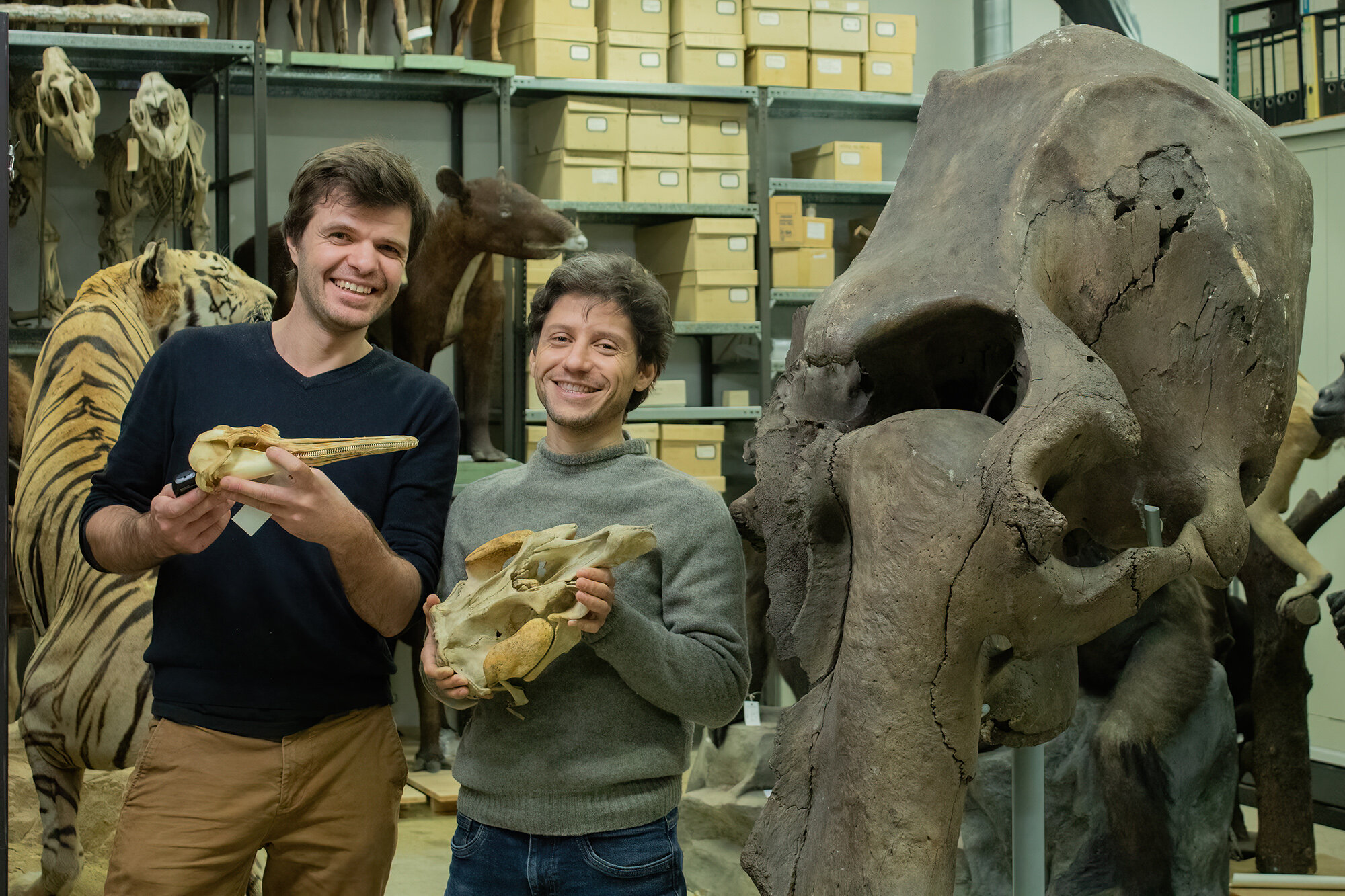
New research shows that scientists can now estimate how keen the sense of smell was in extinct mammals — even when soft tissues (like brain and nose tissues) are long gone. The core insight: many mammal skulls preserve a bony “mold” of the brain region that once housed the olfactory bulbs — the part of the brain that processes smells. This “endocast” can be measured, and its size correlates strongly with the number of functional odor‑receptor genes the species carries. soft tissue does not, this method provides a rare — and powerful — window into the sensory world of long-extinct mammals.
How the Researchers Did It — From Tiny Shrews to Massive Elephants (and Fossils Too)
To validate their approach, the researchers scanned skulls using computed tomography (CT), covering a huge range of mammals — from a 10‑gram shrew to a five-ton elephant.
They reconstructed 3D “endocasts” of the braincase to isolate the portion that contained the olfactory bulbs (in life). Then they compared the volume of that region to the number of intact odor‑receptor genes present in those species’ genomes. The consistent correlation across diverse species confirmed that a larger olfactory‑bulb endocast typically signals a richer repertoire of smell receptors — and hence likely a stronger sense of smell.
Having established this anatomical‑genetic link in living species, they applied the same logic to fossil skulls — where DNA is lost but bones remain. This allowed them to estimate olfaction in extinct species with quantitative confidence.
What They Found — Strong Smell in Many Extinct Mammals
Using this method on a selection of famous extinct mammals revealed surprising results:
-
Some early whales from the Eocene (ancient ancestors of modern whales) had a well‑developed olfactory bulb, indicating they probably had a good sense of smell — unlike many modern whales and dolphins, whose olfactory bulbs shrank during evolution.
-
Predators like the infamous sabre‑toothed cats and other extinct species showed olfactory‑bulb sizes and inferred olfactory‑gene repertoires suggesting they relied on smell more than previously assumed.
-
The extinct marsupial predator thylacine (Tasmanian tiger) also showed evidence of a strong olfactory system — reinforcing the idea that smell was central to its hunting and survival.
These findings overturn some older assumptions that extinct mammals might have been more similar in sensory capacity to modern ones. Instead, many seem to have relied heavily on smell.
Why This Matters — Implications for Evolution, Behavior, and Ecology
Reconstructing Ancient Lives
With this new “nose gauge,” paleontologists can make more informed guesses about how extinct mammals lived — how they hunted, foraged, avoided predators, navigated environments. For example: a strong sense of smell might mean nocturnal hunting, scavenging, foraging for hidden prey, or following scent trails — behaviors otherwise invisible in bones alone.
Understanding Sensory Evolution
The study builds on earlier ideas that enhanced olfaction played a key role in early mammalian brain evolution. Past research suggested that smell — rather than vision — may have driven the expansion of the mammalian brain early on.
This new work provides robust data: a direct anatomical-genetic link across living species, then applied to fossils — offering a long-term view of how the sense of smell evolved (or degraded) over millions of years.
Ecological and Evolutionary Trade‑offs
As mammals diversified and some moved into new niches (e.g., marine life, nocturnal or underground life, vision‑dependent environments), their sensory priorities changed. This method helps trace those shifts: when smell became less important and other senses (vision, hearing, echolocation) took over. For example, early whale ancestors with good smell later evolved into marine cetaceans with reduced olfaction.
A New Tool for Paleontology
This is a methodological breakthrough: by combining skull anatomy and genetic logic, scientists now have a reliable proxy for sensory traits in extinct mammals — something rarely possible before. It opens the door to re‑examining museum fossil collections worldwide, potentially rewriting parts of mammalian evolutionary history. 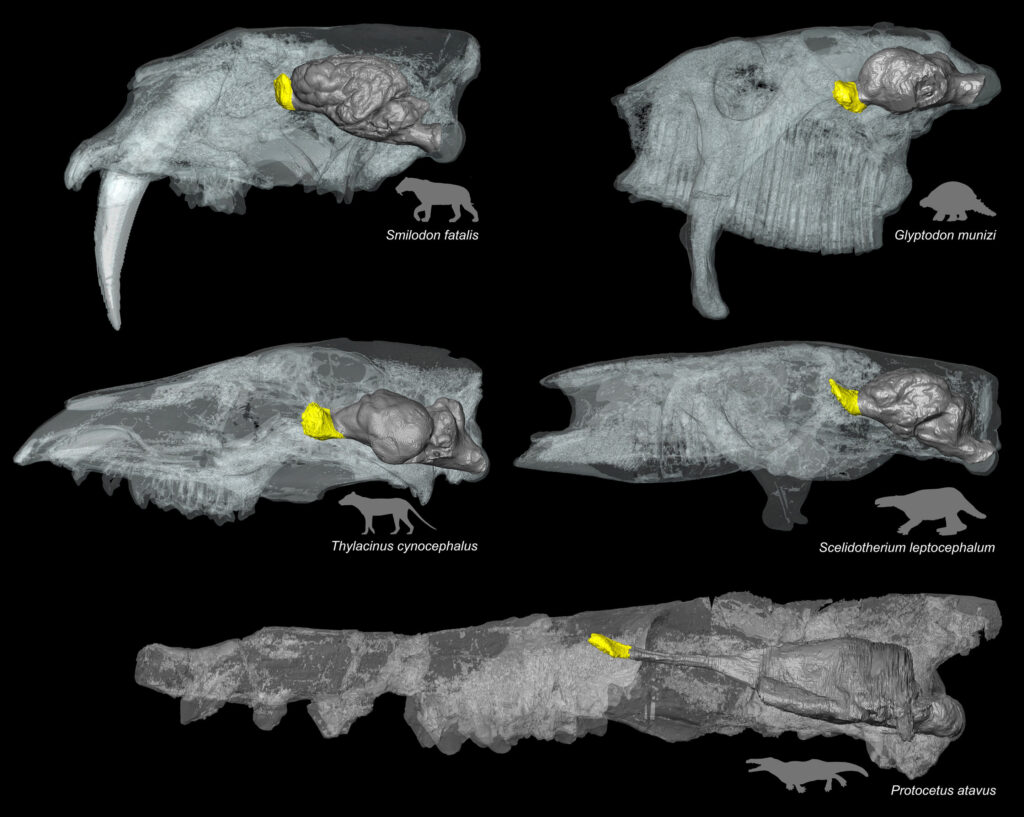
Some Limitations & What It Doesn’t Tell Us
-
The method estimates potential olfactory ability (based on bulb size and receptor genes), but not exactly which smells the animal could detect, how acute discrimination was, or how the smell sense was used behaviorally.
-
Behavior depends on many factors — environment, lifestyle, other senses — so large olfactory bulbs don’t guarantee a scent‑dominated life.
-
Differences in habitat (land vs water, nocturnal vs diurnal) or lifestyle (predator, herbivore, scavenger) influence how smell matters. Reduction in olfactory structures might reflect ecological adaptation, not necessarily “less advanced.”
-
The approach assumes that the anatomical-genetic correlation seen in modern mammals holds for extinct ones — a reasonable but not trivial assumption.
Big Picture — What This Means for Our View of Mammalian History
This study reshapes our understanding of how mammals sensed the world. Rather than vague speculation, paleontologists now have quantitative evidence for olfactory capabilities across deep evolutionary time. It shows that smell has been — and remains — a critical sense for many mammals, ancient and modern.
By providing a bridge from bones → brain anatomy → genes → behavior, the research allows us to reconstruct not just what extinct mammals looked like, but how they might have lived, hunted, foraged, survived. It enriches our picture of ancient ecosystems with sensory depth — not just skeletons, but senses, life, and activity.
Ultimately, “olfaction written in bones” isn’t just a neat trick: it’s a paradigm shift. It gives voice — or smell — to extinct mammals, letting us glimpse their world in a way previously thought impossible.
Read Also: The Race to 300 mph: Will Hennessey or Koenigsegg Break the Speed Record in 2025?
Watch Also: https://www.youtube.com/@TravelsofTheWorld24










Leave a Reply