
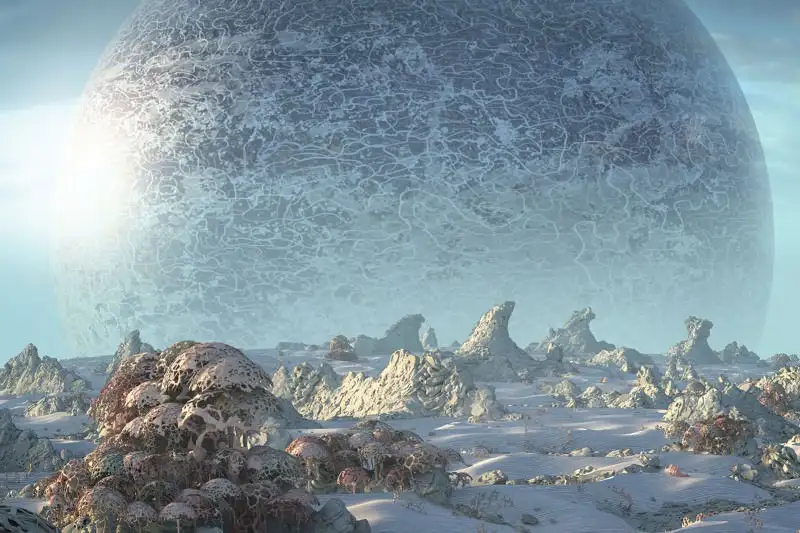
The universe is vast, mysterious, and full of possibilities. Over the past few decades, astronomers have discovered thousands of exoplanets—planets outside our solar system—revealing worlds that challenge our understanding of physics, chemistry, and the very concept of what a planet can be. Some of these alien worlds are stranger than anything found in our own solar system, featuring extreme temperatures, unusual compositions, bizarre orbits, and atmospheric phenomena that defy imagination. This article explores some of the weirdest alien worlds discovered so far and what makes them truly extraordinary.
1. WASP-12b: The Overheated Gas Giant
-
Location: Approximately 1,400 light-years away in the constellation Auriga
-
Type: Hot Jupiter
-
Weirdness Factor: Extreme heat, distorted shape
WASP-12b is a gas giant that orbits extremely close to its star—about 1/44th the distance from Earth to the Sun. This proximity causes surface temperatures to soar above 2,500°C (4,500°F), hot enough to vaporize metals. The planet is so close to its star that it is being pulled apart by tidal forces, giving it an elongated, egg-like shape. In a few million years, it may be completely consumed by its star.
Why It’s Strange: Unlike anything in our solar system, WASP-12b experiences stellar cannibalism, essentially being stretched and devoured by its host star.
2. Kepler-16b: The Real-Life Tatooine
-
Location: About 200 light-years away in the constellation Cygnus
-
Type: Circumbinary planet
-
Weirdness Factor: Double sunrise
Kepler-16b is a circumbinary planet, meaning it orbits two stars instead of one. This setup produces a sky with two suns, much like the fictional planet Tatooine from Star Wars. Despite its exotic sky, Kepler-16b is likely a cold, gaseous world, far too hostile for life as we know it.
Why It’s Strange: Double sunsets are a rare phenomenon in our universe, and the planet’s orbit is dynamically stable despite the gravitational tug-of-war between two stars.
3. 55 Cancri e: The Diamond Planet?
-
Location: 40 light-years away in the constellation Cancer
-
Type: Super-Earth
-
Weirdness Factor: Extreme heat, possible carbon composition
55 Cancri e is a super-Earth with twice the diameter of our planet but eight times the mass. It orbits its star every 18 hours, exposing it to extreme heat of over 2,700°C (4,900°F). Some scientists speculate that its interior could contain large amounts of carbon, possibly forming diamond-like structures under extreme pressure.
Why It’s Strange: A world potentially rich in diamonds flips our understanding of planetary geology and resource possibilities, unlike anything in our solar system.
4. HD 189733b: The Raining Glass Planet
-
Location: About 64 light-years away in the constellation Vulpecula
-
Type: Hot Jupiter
-
Weirdness Factor: Glass rain, hurricane-force winds
HD 189733b is another hot Jupiter, but with a terrifying twist. Its atmosphere is so extreme that it rains glass sideways, driven by winds exceeding 8,700 km/h (5,400 mph). The blue color of the planet comes from silicate particles in the atmosphere, which is more like molten sand than typical gas.
Why It’s Strange: The combination of metallic rain and supersonic winds makes this one of the harshest and most alien environments discovered.
5. TrES-2b: The Darkest Exoplanet
-
Location: About 750 light-years away in the constellation Draco
-
Type: Hot Jupiter
-
Weirdness Factor: Extremely low reflectivity
TrES-2b holds the title of the darkest known planet, reflecting less than 1% of light, even darker than coal or black acrylic paint. Its dark appearance may be due to vaporized sodium and potassium in the atmosphere, which absorb light. Despite its darkness, the planet is blisteringly hot, with temperatures around 1,800°C (3,300°F).
Why It’s Strange: A planet that almost completely absorbs light challenges traditional models of planetary atmospheres and albedo.
6. Kepler-78b: The Scorched Rock
-
Location: About 400 light-years away in the constellation Cygnus
-
Type: Rocky planet
-
Weirdness Factor: Extreme proximity to its star, lava surface
Kepler-78b is a rocky planet orbiting its star every 8.5 hours, closer than any planet in our solar system. The extreme heat has likely melted its surface into lava oceans, turning the entire planet into a molten wasteland. Its orbital speed is so fast that a year lasts less than half an Earth day.
Why It’s Strange: A solid planet with a molten surface and ultra-fast orbit is almost unheard of in our cosmic neighborhood.
7. GJ 1214b: The Water World
-
Location: About 48 light-years away in the constellation Ophiuchus
-
Type: Super-Earth / Mini-Neptune
-
Weirdness Factor: Possible global ocean, exotic atmosphere
GJ 1214b is thought to be a water world, with oceans covering the entire surface. Its atmosphere may contain water vapor, hydrogen, and helium, creating a dense, steamy environment unlike any terrestrial planet. Surface pressure could be hundreds of times that of Earth, making life as we know it impossible.
Why It’s Strange: A planet completely covered in water challenges Earth-centric views of habitability and planetary formation.
8. CoRoT-7b: The Lava Rock
-
Location: About 490 light-years away in the constellation Monoceros
-
Type: Rocky super-Earth
-
Weirdness Factor: Extreme volcanic activity
CoRoT-7b is a rocky planet that orbits very close to its star, completing a revolution in just 20 hours. Surface temperatures reach 2,000°C (3,600°F), likely producing volcanoes and molten lava flows across the surface. Nightside temperatures, though cooler, remain extreme.
Why It’s Strange: The planet’s tidal locking creates a permanent day side of lava and a night side of darkness, a phenomenon unseen in our solar system.
9. Why These Worlds Matter
The discovery of these strange planets helps astronomers:
-
Understand Planetary Formation: Observing diverse exoplanets challenges models based solely on our solar system.
-
Explore Habitability: Extremes of temperature, atmosphere, and composition expand the definition of “habitable.”
-
Study Atmospheric Physics: Exotic atmospheres reveal chemical processes that don’t occur on Earth.
-
Prepare for Future Exploration: Understanding diverse planets informs potential missions to exoplanets or moons.
10. The Future of Exoplanet Discovery
With advanced telescopes like the James Webb Space Telescope (JWST) and next-generation observatories, astronomers expect to discover:
-
Planets with exotic atmospheres (e.g., helium or methane-dominated).
-
Worlds with extreme axial tilts causing crazy seasonal cycles.
-
Planets around binary or trinary stars, producing multiple suns in the sky.
-
Potential habitable exomoons orbiting gas giants.
The universe is almost certainly hiding planets even stranger than those we have discovered so far.
11. Conclusion
The universe is home to incredibly bizarre and fascinating worlds. From WASP-12b’s stretched, overheated body to HD 189733b’s sideways glass rain, these planets push the boundaries of imagination and science alike. Each discovery challenges our assumptions about planetary formation, composition, and habitability. As astronomers continue to search for exoplanets, the cosmos promises to reveal even stranger worlds, further expanding our understanding of the universe and our place within it.
Exploring these alien worlds reminds us that reality can be far more exotic than science fiction, offering a glimpse into the astonishing diversity of planets scattered across the galaxy.
Read Also: Keep your face towards the sunshine and shadows will fall behind you
Watch Also: https://www.youtube.com/@TravelsofTheWorld24












Leave a Reply