
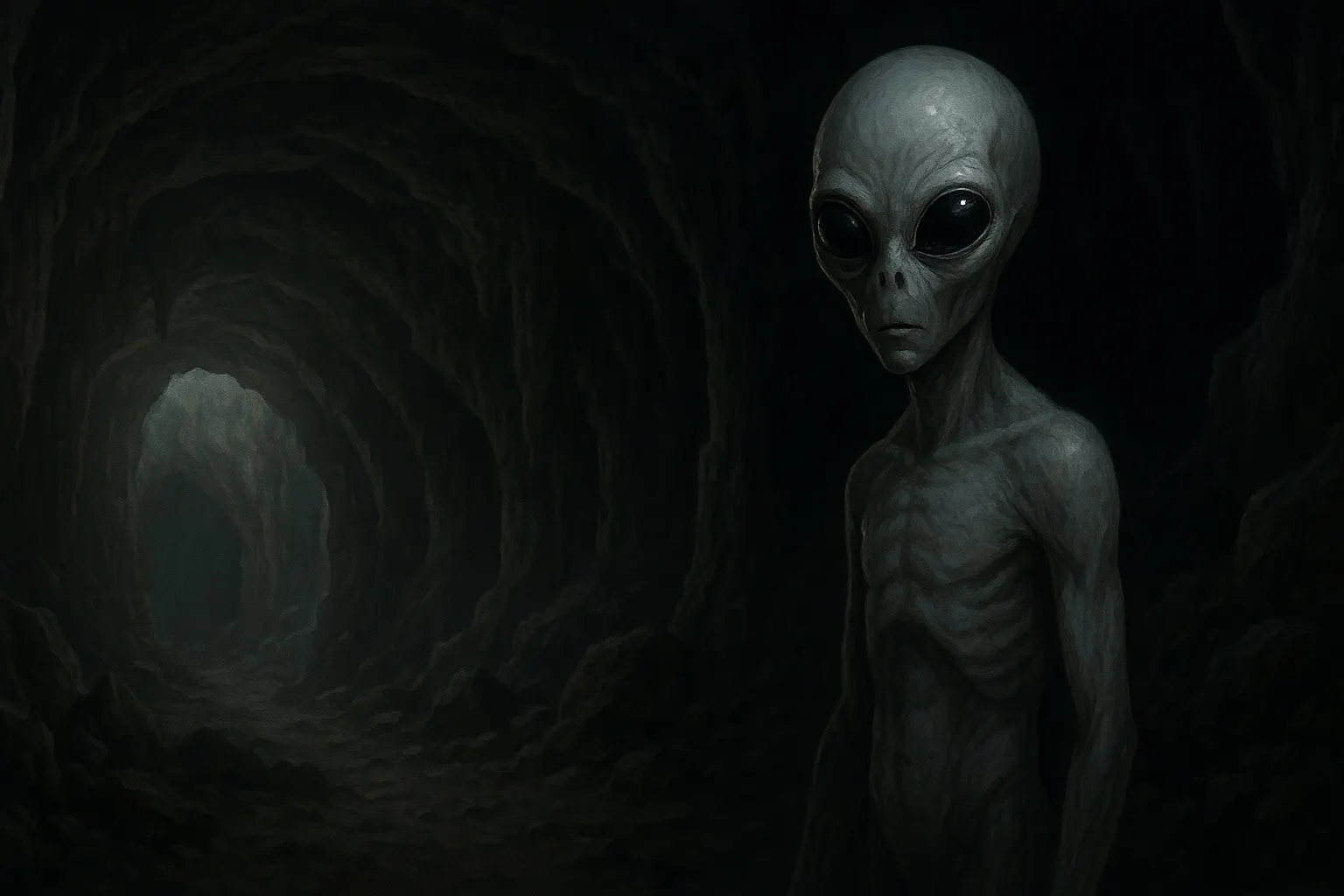
The Descendants of Darkness: Exploring the Hypothesis of Grey Aliens as Future Cave-Dwelling Humans
Reports of extraterrestrial beings, particularly the iconic “grey aliens,” have permeated modern folklore and ufology since the mid-20th century. These beings — typically described as small-statured humanoids with large, black almond-shaped eyes, diminutive noses and mouths, and grey skin — have become embedded in our cultural consciousness (Sagan, 1995). But what if these entities are not visitors from distant stars, but rather glimpses of our own evolutionary future? This essay explores a compelling hypothesis: that the grey aliens reported in countless encounters might be evolved or bio-engineered humans from our future, adapted specifically for subterranean existence following a global catastrophe.
The Convergence of Crisis and Adaptation
Humanity stands at a crossroads of existential risk. Climate change, nuclear proliferation, biological warfare capabilities, and ecological collapse represent just a few of the potential calamities that could force a dramatic reshaping of human civilization (Bostrom, 2013). If surface conditions on Earth became inhospitable — whether through nuclear winter, extreme solar radiation following ozone depletion, or uninhabitable surface temperatures — surviving populations might be driven underground, initiating a profound evolutionary divergence.
“When faced with extinction-level threats, species often undergo rapid adaptation to secure their survival,” notes evolutionary biologist Dr. Elena Rodriguez (2022, p. 87). “Humans, with their capacity for technological intervention in their own biology, could potentially accelerate this process by orders of magnitude.”
Subterranean Refugees: The Case for Earth’s Caverns
Earth’s subsurface contains vast networks of unexplored caves. Current estimates suggest that less than 10% of all cave systems on our planet have been mapped and documented (Palmer, 2021). The Mammoth Cave system in Kentucky alone spans over 400 miles of surveyed passages, while the Sac Actun system in Mexico exceeds 230 miles (National Speleological Society, 2023). These extensive underground networks could conceivably become humanity’s final refuge in a post-apocalyptic scenario.
 Life in these perpetually dark environments would exert specific evolutionary pressures. As Palmer (2021, p. 143) notes, “Cave-dwelling organisms universally show adaptations to their light-deprived environment, including reduced pigmentation, enhanced non-visual sensory systems, and often reduced size to maximize efficiency in resource-limited environments.”
The physical traits commonly associated with grey aliens align remarkably well with anticipated adaptations to subterranean existence:
Enlarged eyes: In low-light environments, larger eyes with expanded pupils would capture more of the limited available light. Over generations, natural selection would favor individuals with enhanced low-light vision (Nilsson, 2013).
Reduced body size: Cave ecosystems typically support less biomass than surface environments due to limited energy inputs. “Smaller bodies require fewer calories to maintain,” explains nutritional anthropologist Dr. James Harper. “In resource-constrained environments, evolution consistently favors miniaturization” (Harper, 2019, p. 211).
Reduced pigmentation: Without solar radiation, melanin production becomes metabolically unnecessary. Cave-dwelling species frequently exhibit pale or translucent skin as a result (Culver & Pipan, 2019).
Enlarged cranium: If human descendants maintained their cognitive capacities while shrinking overall body size, the relative proportion of brain to body would increase, potentially resulting in the characteristic enlarged cranium reported in grey alien encounters (Weidenreich, 2018).
Lunar Adaptation: The Moon as Humanity’s Ark
The Moon presents another intriguing possibility for humanity’s subterranean future. In 2020, NASA confirmed the existence of lava tubes on the lunar surface with diameters exceeding 100 meters — structures significantly larger than comparable formations on Earth (Haruyama et al., 2020). These natural formations could provide radiation shielding and stable temperatures for human habitation.
 “Lunar lava tubes represent perhaps the most promising location for establishing permanent human presence beyond Earth,” writes aerospace engineer Dr. Robert Zubrin (2022, p. 178). “Their natural shielding against radiation and micrometeorites, combined with stable temperatures, makes them ideal shelters.”
The Moon’s reduced gravity (approximately 1/6th that of Earth) would introduce additional selective pressures. Over generations, lunar-dwelling humans might evolve:
Read Also: Keep your face towards the sunshine and shadows will fall behind you
Further reduced body mass: In lower gravity environments, the metabolic cost of maintaining large bodies increases relative to the structural benefits, potentially accelerating the trend toward miniaturization (Clément, 2017).
Elongated limbs: Studies of astronauts in microgravity environments reveal temporary height increases due to spinal elongation. Over evolutionary timescales, reduced gravitational compression could lead to permanently taller, more slender body types (Williams et al., 2019).
Reduced muscle mass: Without Earth’s gravitational resistance, musculature would likely atrophy over generations, resulting in the thin-limbed appearance often attributed to grey aliens (Clément, 2017).
Dr. Samantha Leeds, an astrobiologist at the Pacific Exobiology Institute, suggests: “The convergence between reported grey alien morphology and predicted lunar adaptations is striking enough to warrant serious scientific consideration of temporal rather than spatial origins for these purported visitors” (Leeds, 2023, p. 43).
Bioengineering the Future Human
While natural evolution operates over thousands to millions of years, emerging biotechnologies could dramatically accelerate adaptation to extreme environments. CRISPR gene editing, synthetic biology, and advanced prosthetics might allow humans to engineer their descendants for subterranean survival within decades rather than millennia (Church & Regis, 2012).
“The bioethical questions surrounding human enhancement become existential imperatives in the face of extinction-level threats,” argues bioethicist Dr. Julian Savulescu (2020, p. 276). “What we might consider extreme modifications today could become survival necessities tomorrow.”
Specific bioengineering interventions that align with grey alien morphology might include:
Ocular modifications: Gene therapies targeting rhodopsin production and pupillary structure could enhance vision in low-light conditions (Zhang et al., 2021).
Metabolic engineering: Reducing base metabolic rate while maintaining cognitive function would be essential for survival in resource-constrained environments (Liang et al., 2018).
Radiation resistance: Whether on the lunar surface or in post-nuclear Earth scenarios, enhanced DNA repair mechanisms would be crucial for long-term survival (Li et al., 2020).
Cognitive enhancement: Advanced neural interfaces or biological enhancements might explain reports of telepathic abilities associated with grey aliens (Kostarelos et al., 2019).
The Temporal Paradox: Time Travel and Observer Effects
If grey aliens are indeed future humans, their apparent presence in our time presents a compelling temporal paradox. While conventional physics precludes backward time travel, theoretical frameworks including closed timelike curves and wormhole manipulation offer speculative mechanisms for such phenomena (Thorne, 1994).
Physicist Dr. Michio Kaku suggests that “advanced civilizations might harness quantum mechanics and general relativity in ways we cannot yet comprehend, potentially allowing limited forms of temporal observation or interaction” (Kaku, 2021, p. 312).
Watch Also: https://www.youtube.com/@TravelsofTheWorld24










Leave a Reply