
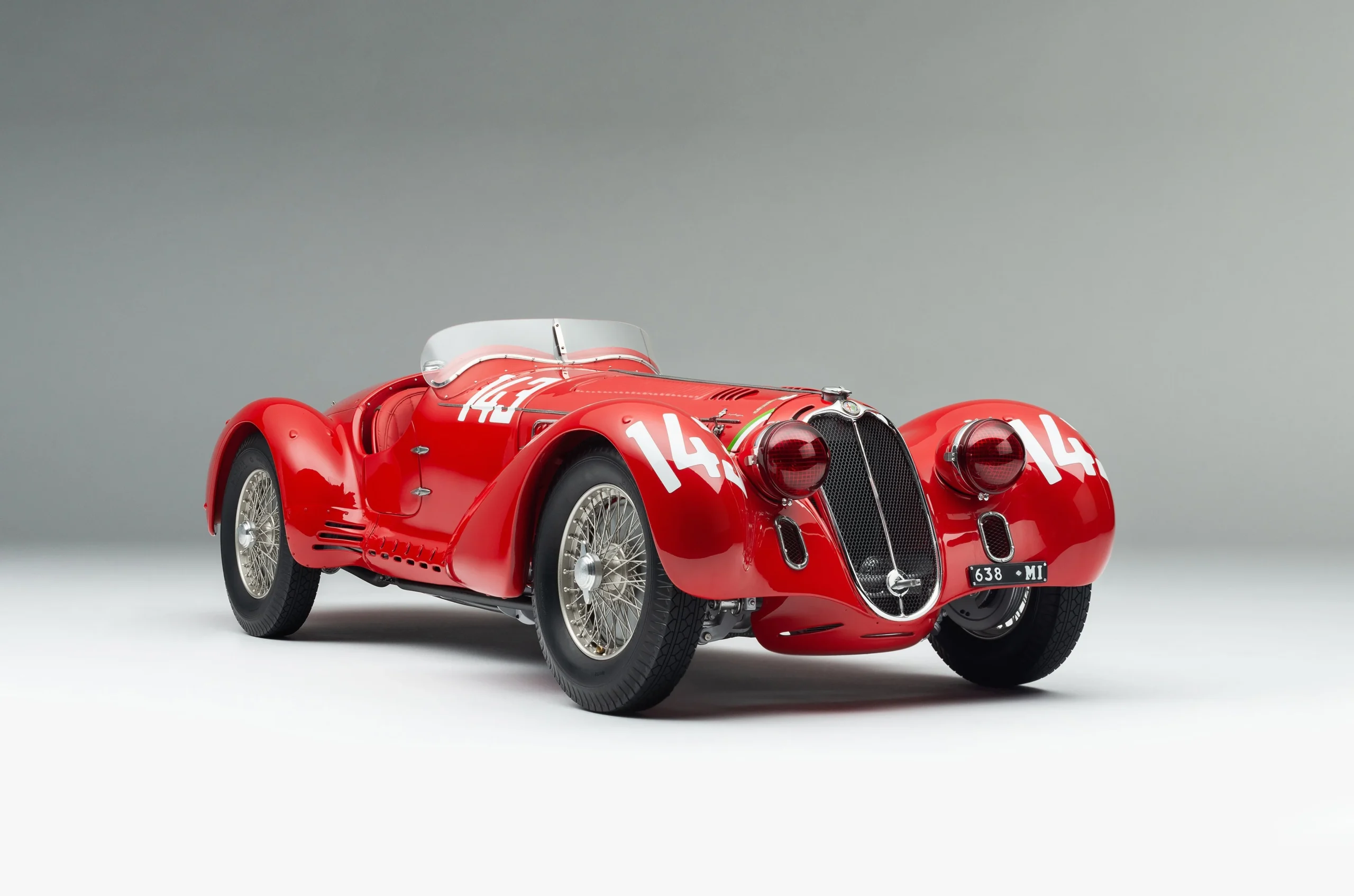
The 1938 Alfa Romeo 8C 2900B Mille Miglia Spider occupies a rarefied place in automotive history. More than just a car, it represents an era — a time when engineering excellence, artistic coach‑building, and racing ambition converged to produce what remains one of the most beautiful and sought‑after sports cars ever built. With a lineage rooted in Grand Prix and endurance racing, and a design aesthetic crafted by master coachbuilders, the 8C 2900B captures both raw mechanical power and refined elegance.
When reproduced as a limited‑edition art print by MotoMirage / Motorology (photography by Michael Furman), this car’s timeless design, curves, and historical gravitas are immortalized — bridging the worlds of automotive heritage, art, and collectible memory.
This essay explores the car’s technical specs, its racing pedigree, its rarity and legacy, and why it matters — both as an object of engineering and as a symbol of 20th‑century automotive artistry.
 Historical & Technical Background
Origins and Engineering Excellence
The 8C 2900 line from Alfa Romeo emerged in the 1930s, built on a Grand Prix–derived chassis. For the 2900B, Alfa Romeo used a 2.9‑litre straight‑eight engine — with dual overhead camshafts and (in racing versions) dual superchargers.
In production 8C 2900Bs, the engine delivered around 180 bhp; for the factory racing versions (like those used in the 1938 racing season) output rose to around 220–225 bhp.
The chassis was offered in two main wheelbase variants: the shorter “Corto” and the longer “Lungo.” Bodies on the 2900B were frequently hand‑built by top Italian coachbuilders; most notably, the open‑top Spider (or “Roadster/Spider”) versions wore coachwork from the famed Carrozzeria Touring — often using lightweight “Superleggera” aluminum techniques to balance performance and style.
Suspension and chassis design were advanced for the time: independent front suspension, a refined rear swing‑axle layout, and a rear transaxle — features that contributed to handling and performance considerably ahead of many contemporaries.
In its day, the 8C 2900B was widely regarded as the fastest production‑capable road/race sports car.
Racing Pedigree & Fame — Mille Miglia and Beyond
What solidified the 8C 2900B’s legend was not just its engineering, but its performance on track. The “Mille Miglia” — the legendary thousand‑mile road race across Italy — was central to that legacy. The 8C 2900B Spider was built with the Mille Miglia specifically in mind.
In the 1938 edition of Mille Miglia, the 8C 2900B Spiders dominated: finishing first and second. One of the victorious cars reportedly used an even more powerful engine — closer to Grand Prix spec — showing how Alfa Romeo leveraged racing tech for decisive advantage.
Beyond Mille Miglia, various 8C 2900s (including 2900B variants) scored victories or strong showings in other major races: endurance competitions, hill‑climbs, and even early road races that would later become historic events.
Therefore this car was not just a “showpiece” — it was a serious contender, a demonstration of engineering meeting competitive demand, reflecting the golden era of pre‑war European motorsport.
Rarity, Survival & Legacy
Very Limited Production
Despite its renown, fewer than about 40 of the 2.9‑litre 8C 2900 chassis were ever built between 1935 and 1939 (all variants combined). Of those, only a handful were fitted with Spider bodies by Carrozzeria Touring — and even fewer remain today.
For the “long‑chassis” Touring Spiders specifically, only about five genuine examples are believed to survive.
Such rarity elevates the 8C 2900B Spider to nearly mythical status among automotive collectors — a status usually reserved for the rarest and most historically significant cars.
Auction Records & Collector Status
The scarcity, pedigree, and beauty of surviving 8C 2900B Touring Spiders drive extremely high collector demand. For instance, one 1938 8C 2900B Lungo Spider recently brought US $14,030,000 at auction through Gooding & Company.
This same car had previously earned accolades: among its history are top awards at high‑prestige concours events like Pebble Beach Concours d’Elegance (2000 — First in Class) and Villa d’Este Concours d’Elegance (1996 — Best of Show).
Because of this — combined with its racing lineage, original coachwork, and mechanical authenticity — the 8C 2900B Spider is often described in collectors’ circles as among the most important, and beautiful, pre‑war sports cars ever built.
Design, Aesthetics & the Art of Coachwork
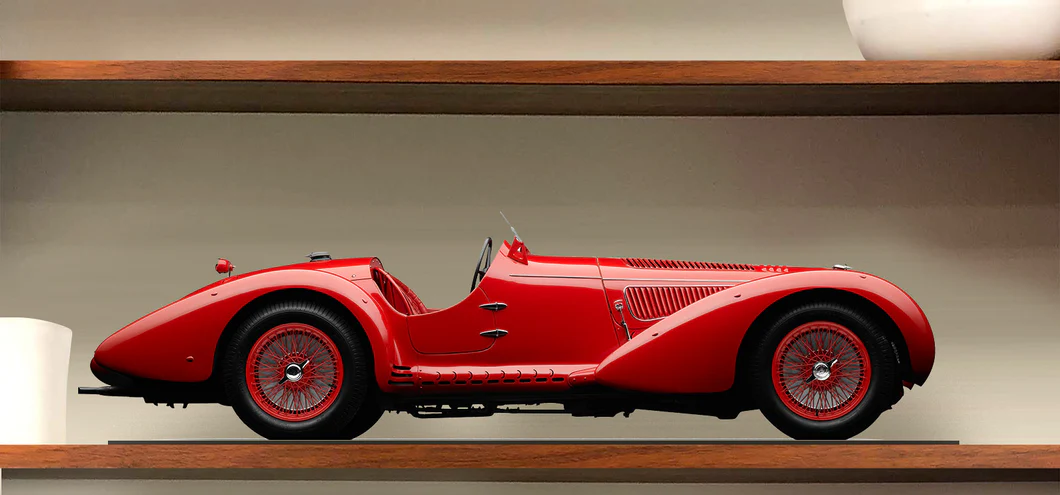
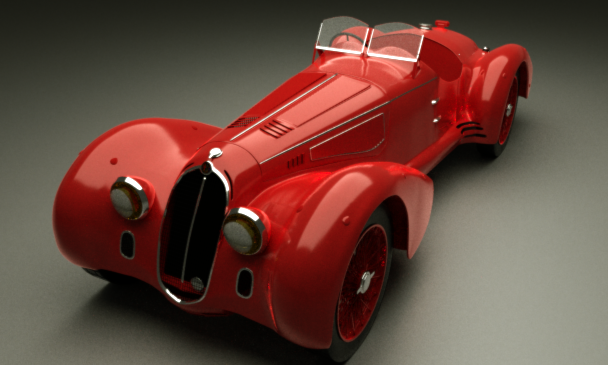
What sets the 8C 2900B apart — beyond its mechanical brilliance and racing success — is its design. The Spider variant embodied the Italian tradition of coachbuilding: flowing lines, a long elegant bonnet, pronounced front fenders, an elongated tail, and a balanced, proportioned roadster body that ground-level car culture rarely matches.
The body design by Carrozzeria Touring — using light “Superleggera” aluminum over a tubular frame — meant the car combined performance with grace, weight savings with aesthetic presence.
Even today, many people regard the 8C 2900B as not just a car but a work of automotive sculpture: where every curve, every proportion, every detail speaks to an age when cars were crafted with hand‑built precision, where racing DNA and elegance coexisted.
That aesthetic legacy is part of why a print or photo of the 8C 2900B — like the MotoMirage limited edition — is more than decoration: it’s a tribute to automotive history, to design, to the human ambition behind machines.
 From Track to Art Print — The Role of MotoMirage & Motorology
The version you selected — the “MotoMirage Limited Edition 1938 Alfa Romeo 8C 2900B Mille Miglia Spider” by Motorology featuring photography by Michael Furman — transforms a legendary automobile into a collectable artwork. According to the listing:
-
It’s a limited edition print — only 50 copies per image.
-
Each print is double‑sided, laser contour‑cut, and packaged in a special folio case.
-
The effect is such that, when displayed on a shelf, it almost resembles a perfect model — bridging the difference between poster, sculpture, and art object.
This transformation from functional racing car to aesthetic object resonates with the history of the 8C 2900B itself: a machine that was as much art as engineering. Through high‑quality photography, careful printing, and edition control, MotoMirage preserves — and shares — the spirit of a car that was built to blur the line between technology and beauty.
In that sense, owning (or viewing) such a print is a way of participating in automotive memory: honoring a vanished age of bespoke craftsmanship, racing daring, and design elegance — long after the original car might rest in a museum or private collection.
Why the 1938 Alfa Romeo 8C 2900B Spider Still Matters
A Milestone in Automotive History
The 8C 2900B represents a high-water mark of pre‑war automotive design and performance. It combined racing‑derived engineering, cutting-edge technology (for its time), and coachbuilt elegance. As such, it influenced both contemporaneous sports cars and subsequent generations of performance automobiles.
It showed that sports cars need not choose between speed and style — that a car could be both a weapon on the road/race track and an object of timeless beauty. That duality resonates for enthusiasts, historians, collectors, and artists alike.
A Symbol of Rarity, Craftsmanship & Legacy
With so few survivors, each example of the 8C 2900B Spider (especially in original condition with correct coachwork) is a cherished piece of heritage. These cars are not just vehicles — they are artifacts, testimonies to an era and a philosophy of car-making that prized craftsmanship, individuality, and excellence.
The fact that modern prints like the one from MotoMirage draw attention to these cars is significant: it means that the legacy isn’t just preserved physically — in garages, museums, auctions — but also visually and culturally, accessible to a wider public who can appreciate the design even if they never sit behind the wheel.
Inspiration & Cultural Memory
Cars like the 8C 2900B Spider inspire not only car lovers, but also designers, artists, and storytellers. Their lines influence concept cars, their history enriches automotive narratives, their mystique fuels fascination across generations. The printing of such cars as limited‑edition art pieces helps archive that memory — turning fleeting speed and mechanical perfection into something enduring and shareable.
Conclusion — The 1938 Alfa Romeo 8C 2900B Spider: A Legend Immortalized
The 1938 Alfa Romeo 8C 2900B Mille Miglia Spider stands as one of the greatest cars ever engineered: rare, powerful, beautiful, and historically significant. It was born to race, built to thrill, designed to enchant — and it achieved all.
As time passes, surviving original examples become more precious, and their stories more poignant. Meanwhile, representations such as the MotoMirage limited‑edition print offer a way for more people to access, appreciate, and remember these machines — not just as vehicles, but as art, as history, as cultural memory.
In the 8C 2900B we find a perfect fusion: racing heart and Italian artistry; engineering prowess and coachbuilt elegance; mechanical roar and timeless form. For anyone fascinated by automobiles, design, or history — the 8C 2900B Spider is not just a car. It is a legend.
Owning, studying, or simply admiring it — or even a photographic print of it — invites reflection on why we love machines, why we preserve them, and why some objects transcend their original purpose to become icons of their time.
Read Also: Keep your face towards the sunshine and shadows will fall behind you
Watch Also: https://www.youtube.com/@TravelsofTheWorld24









Leave a Reply