
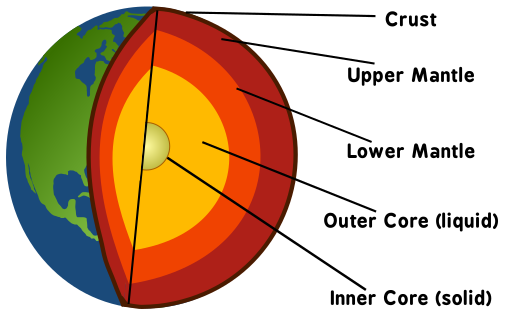
Earth is a dynamic and complex planet with a structure that has fascinated scientists for centuries. Beneath the surface we walk on lies a series of layers, each with unique properties, compositions, and roles that contribute to the planet’s stability and activity. Understanding the layers of the Earth is essential in geology, geophysics, environmental science, and planetary studies. By studying these layers, scientists can explain phenomena such as earthquakes, volcanic eruptions, mountain formation, and the Earth’s magnetic field, while also gaining insight into its history and evolution.
The Earth is not a uniform body but is made up of distinct layers that vary in thickness, composition, and physical state. Broadly, these layers include the crust, mantle, and core. Scientists have discovered much about these layers using seismic waves, volcanic rocks, laboratory experiments, and computer modeling. Each layer plays a critical role in supporting life, driving geological processes, and maintaining Earth’s dynamic equilibrium.
1. The Crust: Earth’s Surface Layer
The crust is the outermost layer of the Earth and forms the solid surface on which we live. Although relatively thin compared to the other layers, the crust is vital as it supports ecosystems, contains natural resources, and participates in geological processes.
a. Types of Crust
The crust is divided into two types:
-
Continental Crust:
This forms the continents and is typically 30 to 70 kilometers thick. It is composed mainly of granitic rocks rich in silica and aluminum, making it less dense than oceanic crust. Continental crust contains mountains, plateaus, and vast land areas. -
Oceanic Crust:
Found beneath the oceans, oceanic crust is thinner, usually 5 to 10 kilometers thick, and denser than continental crust. It consists primarily of basaltic rocks rich in iron and magnesium. Oceanic crust is continuously formed at mid-ocean ridges and eventually recycled into the mantle at subduction zones.
b. Composition
The crust consists of silicate minerals such as quartz, feldspar, and mica. It contains oxygen, silicon, aluminum, iron, calcium, potassium, and magnesium. These elements form rocks that provide resources and habitats essential for life.
c. Importance
The crust supports life, houses natural resources, and forms the tectonic plates that drive geological processes. Earthquakes, volcanic activity, and mountain formation are all related to movements within the crust.
2. The Mantle: The Middle Layer
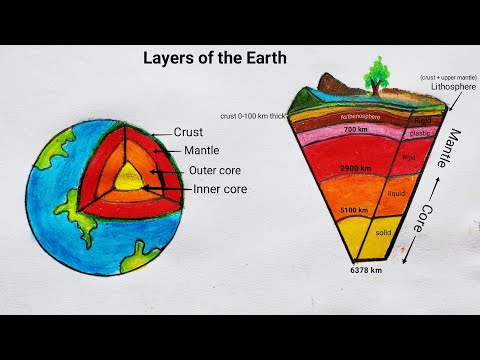
Beneath the crust lies the mantle, the thickest layer of the Earth, extending to a depth of about 2,900 kilometers. The mantle is primarily solid but behaves like a slow-flowing fluid over long periods, enabling tectonic plates to move.
a. Structure of the Mantle
The mantle can be divided into:
-
Upper Mantle:
Extends from the base of the crust to about 670 kilometers deep. It includes the asthenosphere, a partially molten layer that allows tectonic plates to move. The lithosphere, which includes the crust and the uppermost mantle, is rigid and forms the tectonic plates. -
Lower Mantle:
Extends from 670 kilometers to 2,900 kilometers deep. This layer is more rigid due to higher pressure but still flows slowly over geological time, driving mantle convection that influences surface geology.
b. Composition
The mantle is composed primarily of silicate minerals rich in magnesium and iron, including olivine, pyroxenes, and garnet. It contains about 67% of Earth’s mass and acts as a bridge between the crust and core.
c. Importance
Mantle convection drives plate tectonics, volcanic activity, and recycling of crustal materials. The mantle also stores heat from the Earth’s interior, which fuels geothermal energy and indirectly influences the magnetic field.
3. The Core: Earth’s Innermost Layer
The core lies beneath the mantle and extends to the center of the Earth, about 6,371 kilometers from the surface. Composed mainly of iron and nickel, it is divided into two layers: the outer core and the inner core.
a. Outer Core
The outer core is a liquid layer approximately 2,200 kilometers thick. Its flow generates the Earth’s magnetic field through the geodynamo process. Movement of molten iron and nickel creates electric currents, producing a protective magnetic shield around the planet.
b. Inner Core
The inner core is solid with a radius of about 1,220 kilometers. Despite extremely high temperatures exceeding 5,000 degrees Celsius, immense pressure keeps it solid. The inner core is primarily iron and nickel, playing a critical role in maintaining the magnetic field and driving dynamic processes in the outer core.
c. Importance
The core’s activity protects life on Earth by generating the magnetic field that shields the planet from harmful solar radiation. Heat from the core drives mantle convection, which powers plate tectonics and influences volcanic and seismic activity.
4. Methods of Studying Earth’s Layers
Since humans cannot directly access most layers of the Earth, scientists rely on indirect methods:
a. Seismology
By studying seismic waves generated by earthquakes, scientists can determine the density, composition, and state (solid or liquid) of various layers. P-waves travel through solids and liquids, while S-waves only move through solids, helping to map the Earth’s interior.
b. Laboratory Experiments
Experiments simulating high-pressure and high-temperature conditions provide insight into the behavior of rocks and minerals deep within the Earth.
c. Volcanic Rocks
Volcanic eruptions bring mantle material to the surface. Studying these rocks helps scientists understand mantle composition and behavior.
d. Geophysical Surveys
Techniques such as gravimetry, geomagnetism, and heat flow measurements allow scientists to infer the distribution of materials within the Earth.
e. Computational Models
Advanced computer simulations integrate observational data with physical principles to model Earth’s interior and predict its behavior.
5. Interactions Between Earth’s Layers
Earth’s layers interact constantly, creating the dynamic planet we experience:
-
Plate Tectonics: Mantle convection moves tectonic plates, causing earthquakes, volcanic eruptions, and mountain formation.
-
Volcanism: Mantle material rises to the surface, forming new crust.
-
Magnetic Field: Movement of the outer core generates a magnetic field that protects life.
-
Heat Transfer: Heat from the core and mantle drives geological activity at the surface.
-
Material Recycling: Subduction returns crustal material to the mantle, contributing to the rock cycle.
These interactions demonstrate that Earth’s layers form an interconnected and constantly evolving system.
 6. Importance of Understanding Earth’s Layers
Studying the Earth’s layers has numerous practical and scientific benefits:
a. Natural Disaster Preparedness
Knowledge of earthquakes, volcanoes, and tectonic activity allows societies to prepare for and mitigate natural disasters.
b. Resource Management
Understanding the Earth’s interior helps locate minerals, fossil fuels, geothermal energy, and groundwater.
c. Climate and Environmental Studies
Mantle and core processes influence volcanic emissions and long-term climate cycles, important for environmental planning and sustainability.
d. Scientific Discovery
Studying Earth’s layers reveals information about the planet’s formation, evolution, and comparison with other planets.
e. Education and Awareness
Learning about Earth’s structure fosters scientific literacy and a deeper understanding of the planet’s complexity.
7. Conclusion
The Earth is a layered planet with each layer—crust, mantle, and core—playing a crucial role in shaping the surface, protecting life, and driving geological processes. The crust supports life and contains resources, the mantle drives tectonics and volcanism, and the core generates the magnetic field essential for life. By studying seismic activity, volcanic rocks, and using advanced modeling techniques, scientists continue to uncover the mysteries of the Earth’s interior, improving our understanding of natural hazards, resource management, and planetary evolution.
Earth’s layers interact continuously, making the planet a dynamic and ever-changing system. A thorough understanding of these layers is essential for disaster preparedness, sustainable resource use, and advancing scientific knowledge. Studying Earth’s structure reminds us of the planet’s complexity and the importance of preserving its delicate balance for future generations.
Read Also: Keep your face towards the sunshine and shadows will fall behind you
Watch Also: https://www.youtube.com/@TravelsofTheWorld24









Leave a Reply