

Alien Embodiment and the Limits of the Cyborg Concept
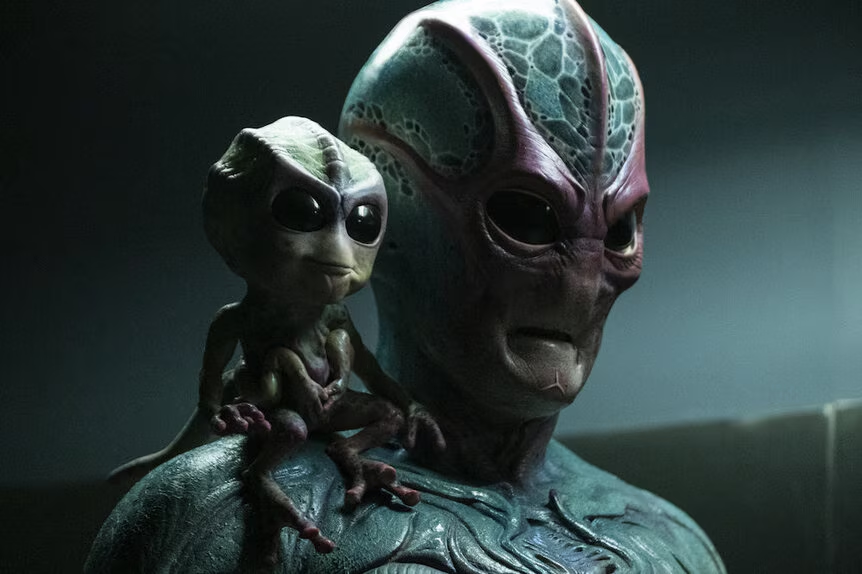
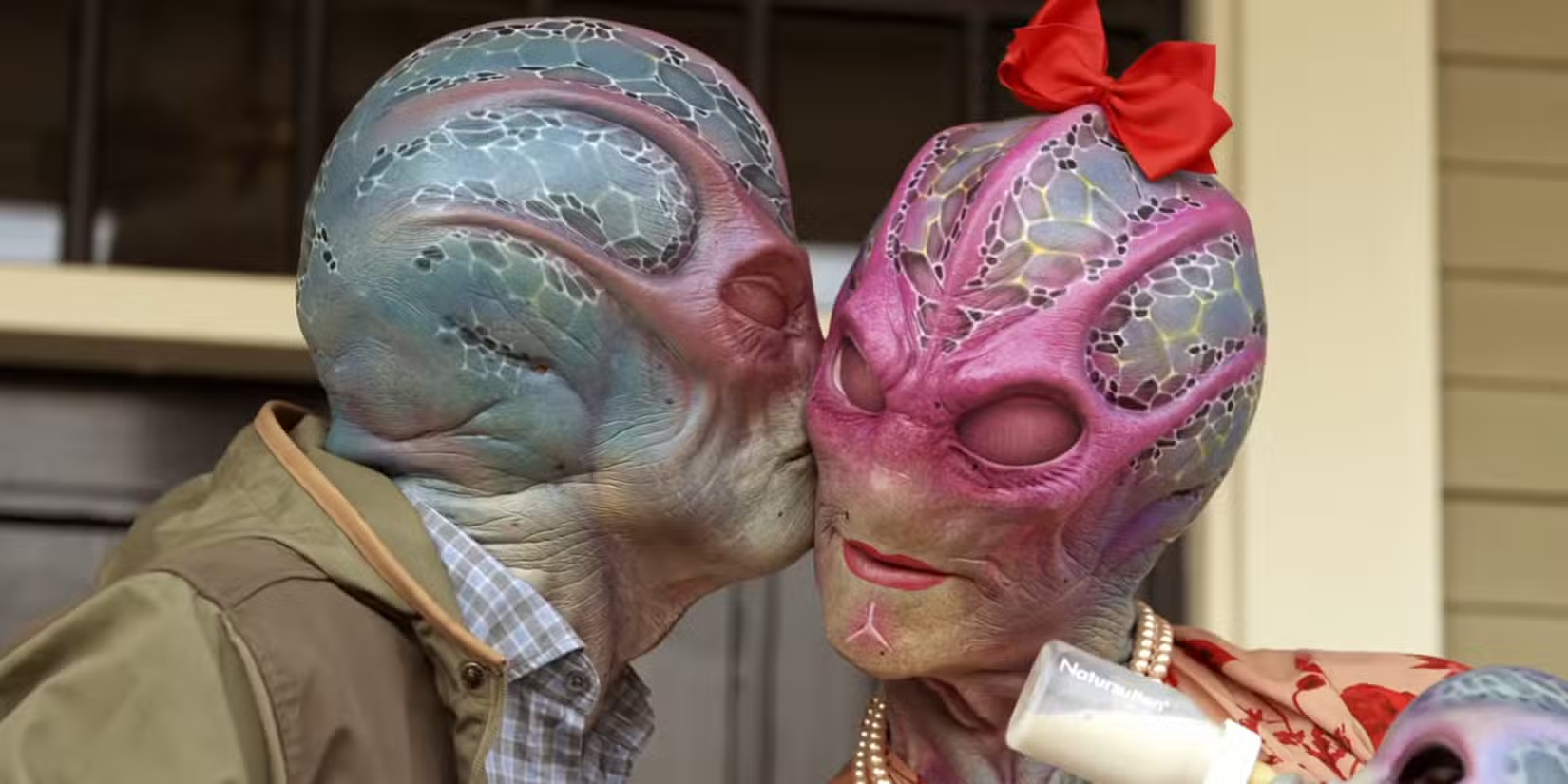
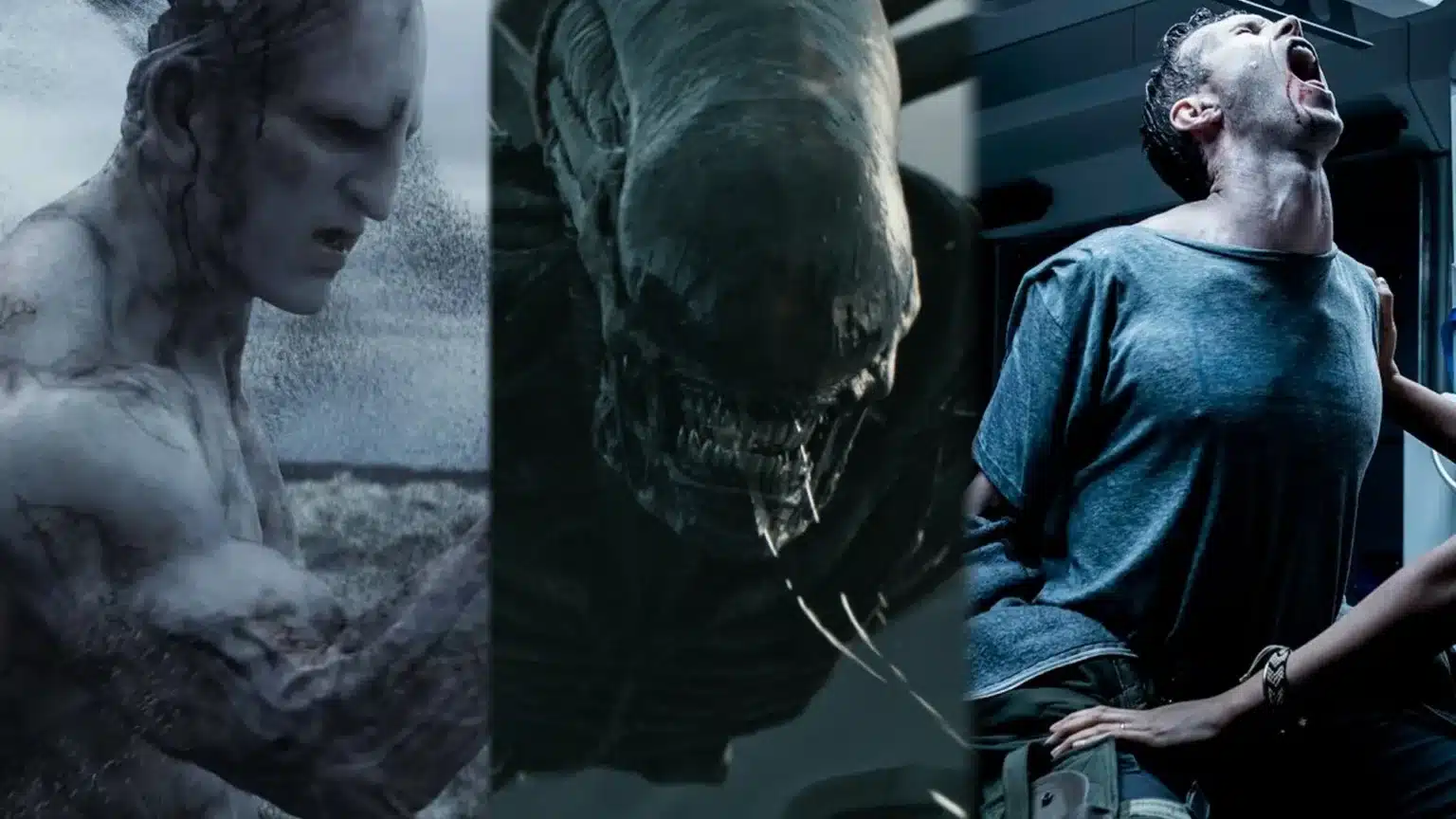
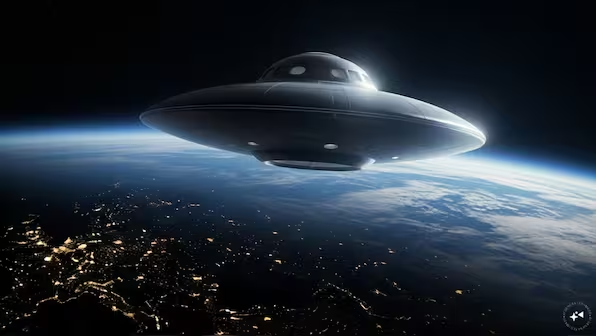
In testimony after testimony, abductee after contactee, the alien beings described do not shimmer with chrome limbs or whisper in modulated vocoder tones. They are lithe, smooth-skinned, sometimes hairless, sometimes luminous, often described as more organic than mechanical, more bioengineered than bolted together. If one takes the speculative leap — which countless serious thinkers have entertained (e.g., Vallée, 2014; Kripal, 2016) — that alien entities exist and interact with humans, then the consistent absence of machine-augmented bodies in these encounters deserves philosophical attention. Why are these alleged visitors not cyborgs?
Posthumanist theory, from Haraway’s foundational Cyborg Manifesto (1991) onward, has celebrated the hybrid figure of the cyborg as both metaphor and model for overcoming the binary logics of human/animal, natural/artificial. Yet in the field reports of alien encounters, what we get is not the chimera of wires and flesh but beings whose embodiment appears entirely organic. They exhibit advanced capabilities — levitation, telepathy, multi-dimensional travel — yet their form remains strikingly whole, smooth, grown rather than assembled. This preference, if it can be so named, suggests something significant about the experiential implications of embodiment, and by extension, about the likely trajectory of human technological augmentation.

Maurice Merleau-Ponty, whose phenomenology of perception returns embodiment to its rightful primacy, would likely not have been surprised. In his view, “The body is our general medium for having a world” (Merleau-Ponty, 1962, p. 146). The body is not a container for cognition, nor an interface for data; it is the locus of being, the intertwining of perception and action. Any interference with this seamless medium — whether through prosthesis, invasive implants, or clumsy augmentations — risks alienating the being from its world. The alien, it seems, has optimized for precisely the opposite: a full saturation in its world. Its enhancements, if any, are biologically seamless. Telepathy, often reported in encounters (e.g., Mack, 1994; Strieber, 1987), does not require a neuralink but emerges as an embodied communicative capacity. From a phenomenological standpoint, this makes sense: why fracture the medium of perception with technological intrusions when the body can evolve more subtle and total capacities?
Reports in the ufological literature repeatedly underscore this preference. In the vast catalogue compiled by the Mutual UFO Network (MUFON) and the National UFO Reporting Center (NUFORC), entities described in abduction or contact scenarios are consistently presented as biologically coherent. Consider the case studies collected by Harvard psychiatrist John E. Mack (1994), whose clinical interviews reveal entities described as having large black eyes, small mouths, and thin humanoid forms, but rarely anything resembling mechanical parts. Similarly, in Jacques Vallée’s extensive research (Passport to Magonia, 1969; Dimensions, 2008), even when alien behaviors suggest high technological sophistication, their appearance remains unsettlingly biological. They glide, they glow, they communicate directly into the mind. They do not whirr.
In fact, the image of the cyborg seems almost quaint in contrast to these accounts. The cyborg presumes a logic of supplementation — an insufficient body made whole by machine. But the alien, as described, offers a different vision: the optimization of organic form, the reengineering of flesh itself. We see here the outlines of a shift from cybernetics to genomics, from prosthesis to biogenesis. Genetic engineering, long a speculative theme in science fiction, is now well within scientific reach. CRISPR and similar techniques enable the precise editing of genetic codes (Doudna & Sternberg, 2017). One imagines that any civilization capable of interstellar travel would have long since mastered the ability to tailor biological organisms to purpose. In such a framework, the body does not require a robot arm; it grows the strength of ten arms in a single limb, or perhaps communicates without needing to speak at all.

Embodied cognition theories (Varela, Thompson, & Rosch, 1991) affirm this logic. Cognition is not computation in the brain but arises from the dynamic coupling of body and environment. An entity that moves via antigravity or sees across dimensions likely perceives in ways utterly foreign to us, but still grounded in a body optimized for those perceptual acts. Telepathic communication, for instance, would not be “mind reading” in the Hollywood sense but the direct attunement of embodied intelligences. In this light, Haraway’s cyborg, as an ironic myth of resistance to humanist dualisms, may be giving way to something less ironic and more biological: the posthuman entity as fully integrated biosystem, not patched-together machine.
There are outlier reports, to be sure. Whitley Strieber (1987) mentions beings that seem to operate machinery, and certain obscure testimonies (e.g., those catalogued by Albert Rosales in The Humanoid Encounters) mention more mechanistic figures. But even these are rarely described as cyborgs in the strict sense. When mechanical beings appear, they tend to function as drones or probes — external devices operated by the central (organic) intelligence. The implication is that mechanical extension is reserved for expendable or limited tasks, not for the self.
Design theory and human-computer interaction similarly support this vision of distributed, environmental tech. Mark Weiser’s vision of ubiquitous computing (1991) foresaw a world in which technology “weaves itself into the fabric of everyday life until it is indistinguishable from it” (p. 94). In such a context, telepathy is not magical but the logical endpoint of cognitive engineering that removes friction between body and environment. The alien does not wear technology; it lives in an environment saturated with it, seamlessly entangled. And this, too, fits the phenomenological picture: the optimal interface is no interface.
Read Also: Keep your face towards the sunshine and shadows will fall behind you
Watch Also: https://www.youtube.com/@TravelsofTheWorld24








Leave a Reply